Monday, July 8, 2024

Vincent Namatijira - Australian National Gallery

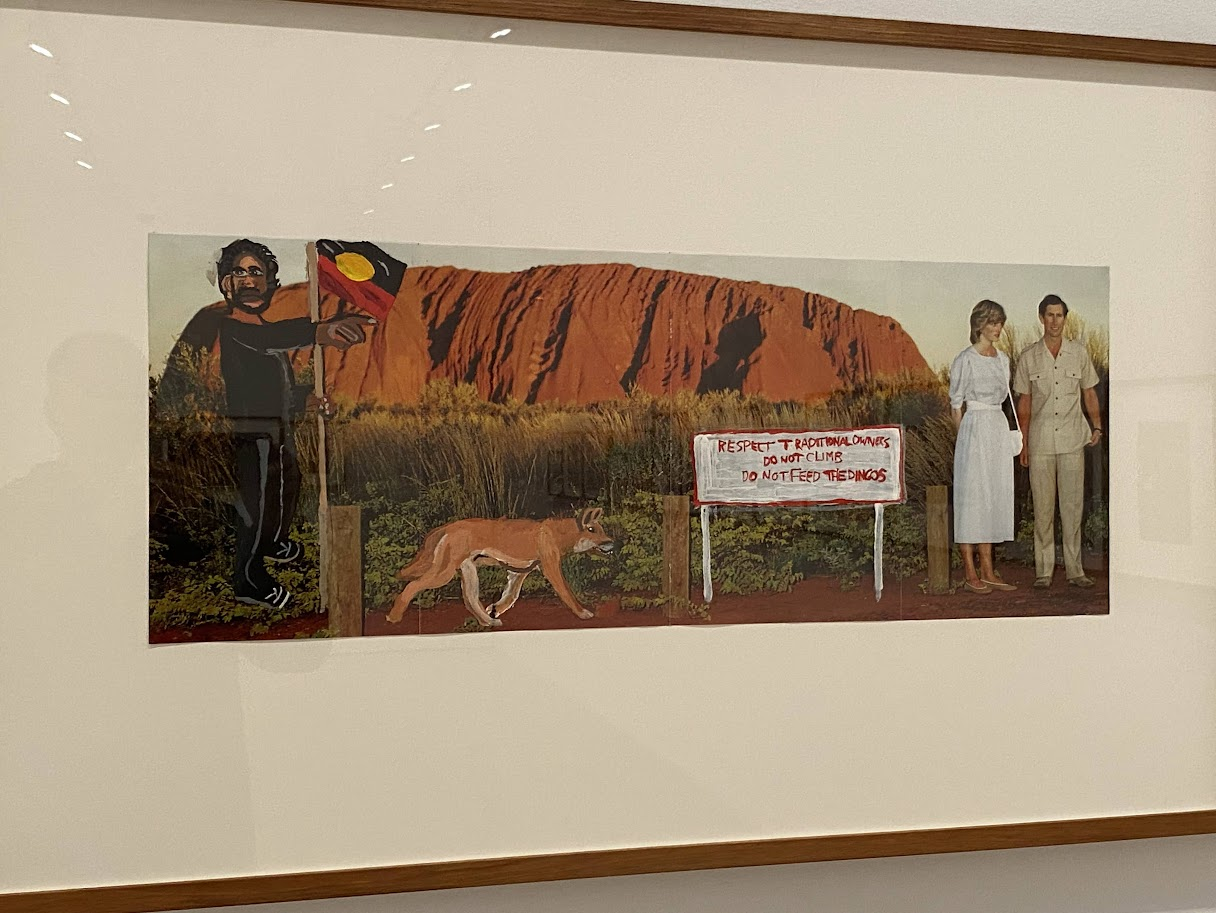
Audrey and I went to visit Vincent Namatijira's exhibition at the National Gallery. Vincent Namatijra is Great-Grandson of renowned Australian watercolour artist Albert Namatijra and like his great grandfather has also taken up the paintbrush.

Unlike Albert's work (which tends to be beautiful, but classic) Australian landscapes, Vincent specialises in portraiture, and it was for this he won the Archibald Prize (an Australian portrait competition) in 2020.

His paintings are of a distinctive style - bright and bold colours painted with acrylic or watercolour. His paintings have been described as caricatures.  Often he paints famous people alongside self portraits of himself standing as the artist. His paintings frequently reference Captain Cook, or the Royal Family.

One such painting was of mining magnet Gina Rinehart. Remarkably Rinehart took objection to his portrait of her and asked that the gallery take it down. This included (but never actually confirmed) sending members of the Australian swimming team (who she partially funds) to request the gallery remove it (I've no idea whether they intended to do it by force?)

Either way, both the gallery and Vincent Namitijira rebuffed her requests but the media storm that blew up as a result let to a huge focus both on his work as an artist and also the exhibition.

I must admit that without the focus it's unlikely that I'd have gone along. I knew of his work but I wasn't a big 'fan' but I'm so glad that the articles I read detailing Rinehart's protestations undoubtedly led to me and (probably several thousand others) going along.

What Audrey and I found though was that his paintings were so much more than just one controversial and (in my opinion) excellent painting. His work is impactful, funny but also with a message. Both Audrey and I really enjoyed it, particularly a room where you could create your own painting in the same style as the artist. It was a fun and interesting afternoon out!


The controversial portrait


With Charles and Diana at Uluru


Monday, February 27, 2023

The Indigenous Voice to Parliament

While tomato-less Britains flick hungrily through their latest Jamie Oliver turnip recipe book, Australia ponders its next big mass information gathering exercise which is the referendum for an indigenous voice to parliament.

Australia approaches the referendum with a chequered recent history of data collection. The 2016 Australian census which encouraged 100% online participation flopped due to an utter failure of planning and testing. Assuming some distant out-back camel farmer would be as IT savvy as a public servant rushing from their desk to fill their keep-cup with a 9.30am latte was one thing, but the $10 million system built by IBM crashed on census night in a big way - insufficient ‘load testing’ apparently. The computer certainly did say no. Those who could get through also typically recorded their religion as Jedi beating Catholicism into second place which further screwed up the whole sorry mess.

By the following year in 2017 the Australian government introduced a new word into the vernacular with a national same-sex marriage ‘plebiscite’. Apparently, a plebiscite is kind of like a referendum, but the government has a get out clause in that it can ultimately change the result if it likes at the end of it.  Essentially it is the model that SHOULD have been used for the Brexit referendum, but instead was applied to marriage equality which the majority of Australians were happy to support, but instead the government threw $160 million at the question just to make really really really sure.

Australia now has a further two referendums to consider. An election promise when Labor swept to power in 2022 committed to a vote on an indigenous voice to parliament and assuming they win the next election (which given the somewhat sinister yet comical conservative opposition appears likely) we’ll next have a second referendum for an Australian republic in which the misdemeanours of Charles, Camilla, Andy, Harry and co. get raked over again before the inevitable conclusion that they head off into the sunset and we change our coins to have an effigy of Shane Warne on them. Presumably we’ll then also change the design of the Australian flag which is a little bit dated and embarrassing currently.

So, what exactly IS the indigenous voice to parliament that everyone in Australia will be voting on? Essentially, it’s a body made up of indigenous Australians (Aboriginal and Torres Strait islander people) which is recognised in the constitution and allows them to provide advice to Parliament on policies and projects that impact their lives.

It represents the next step in a journey which goes back almost to the European invasion in 1788. A few years following this Governor Richard Bourke declared Australia ‘terra nullius’ (literally belonging to no-one) conveniently forgetting that there were possibly up to one million people living (effectively and efficiently) in the continent before convicts and settlers arrived bringing small-pox and other horrors from the ‘new world’ with them decimating indigenous Australia for ever more.

Electing a Voice to Parliament seems to make sense. The Close the gap campaign which commenced in 2007 becomes increasingly embarrassing every year as the ‘gap’ of indigenous disadvantage widens rather than closes. I was (and remain) optimistic about the Voice. Like the marriage equality plebiscite before it and the republic referendum which will follow it, I suspect it will be voted for by a majority of Australians.

What’s become interesting over the last few weeks though is opposition to it. Peter Dutton, the sinister looking leader of the Liberals has declared that he’s undecided on whether he’ll support it or not and given his previous questionable attitudes toward aboriginal inclusion it’s fairly easy to guess which way he’ll go. Opposition has also come from within the indigenous community. Senator Jacinta Price has declared the Voice as divisive and unfair. The issue she sees is that it’s almost impossible to build a truly representative panel. At the time of colonisation it’s thought that there were almost 500 tribes in Australia, each with their own distinct language and territories. It’s impossible therefore to imagine an advisory body genuinely representing even a fraction of that number. Unlike New Zealand where a treaty (The 1840 Treaty of Waitangi) was signed with the Māori’s no such treaty was ever signed with Australia’s indigenous population. As a result Captain Cook was revered and a copy of the Magna Carta is on display in Parliament House in Canberra.

So the Voice has opposition from two unlikely bed-fellows – the Liberals, trying to avoid the sheen slipping off their arguments to reveal their right-wing racist views and some within the aboriginal community saying that the Voice doesn’t go far enough and is not in the least bit representative.

The result therefore is likely that voters will most likely end up being confused. It could therefore go the same way as Brexit, but more likely will pass and be implemented. My fear for the advisory board then is that it has no real substance and awkward issues for Australia, which have built up over generations such as indigenous suicide and often appalling health and welfare outcomes are simply shunted for someone else to ‘fix’ I guess we’ll see. If nothing else I just hope the technology works this time.

Friday, December 30, 2022

Joe comes to visit

 My Godson Joe is visiting Australia from the UK at the moment. He's worked his way up the east coast to Cairns and then came to stay with us for a week in Canberra (and the south coast).

He's organised his trip really well and seems to be very on top of both his plans and his budget. It was lovely to see him and the kids both enjoyed having a new face around (rather than their nagging old Dad).

While he was staying with us we took a trip down to Pambula on the south coast of NSW. It's a lovely spot and both Pambula and its neigbouring bigger brother, Merimbula are nice towns. They have a real sea-sidey feel with a good split between locals and holiday-makers.

We'd last visited in January and so we knew our way around the campsite as well as the local streets and shops. It's a bit further on from Bateman's Bay (where most Canberrans take summer breaks) but we still ran into a neighbour while we were crossing the road in Merimbula.

We took a fishing trip with Scott who runs the excellent Fishpen Charters and caught about 8-9 decent sized fish, ranging from Sweep, through to Nannygai (Red fish) and delicious Snapper that we froze and ate on Christmas day. Poor Eli got seasick about an hour into the trip so didn't do much fishing on this occasion.

On our second day we took a great walk along the beach to Merlimbula. It's about 5km and so we took a packed lunch and ate it by the side of the lake before walking back to the campsite. We also took a trip to Bega Christmas fayre which was a fun (and local) affair.

Magic Mountain in Merimbula is always a fun day out as well and we spent a sunny day there, variously riding, putting and swimming.

We raced back to see a Christmas Carol playing at Canberra Theatre. It was a fabulous production and put everyone there in the Christmas spirit.

Gingerbread house

catch of the day


Our bag of fish and a snapper


Bega Christmas craft

Magic Mountain, Merimbula


Sunday, October 2, 2022

Day trip to Rendezvous Creek rock art

 Audrey and Eli spent the week with their auntie in Darwin. It was the first break I had had in (literally) years and so I took the opportunity to visit the beautiful Namadgi national park.

I was particularly keen to see the aboriginal rock art at Rendezvous Creek.

There's several (I think seven) locations in the Namadgi where aboriginal rock art can be found. The most 'famous' is the artwork at Yankee Hat. The Morrison bushfires of 2019/20 engulfed the area of the park where that particular rocky overhang is found but the ACT government and national park successfully saved it. The fires did however damage the area around it and the long boardwalk which used to allow access has now been removed. There are plans to re-open the rock art site (and archaeological site underneath) within a year.

The aboriginal community have not given specific approval for Rendezvous Creek and Nursery Swamp where other rock art is located to have official trails or be officially advertised. They are however 'open' and starved of the ability to visit Yankee Hat I decided to head out and see if I could locate them.

I'd researched the approximate area of the Rendezvous Creek artwork. It was a decent hike of about 14km return. I left around mid-morning and drove to the car park area.

More recently the national park has introduced a circular walk in Rendezvous Creek. It's a nice walk down by the creek and is a short circular walk of around 3 or 4km.

It had rained for a fair bit of the week leading up to my trip and so the ground was really wet underfoot. I initially wore trainers but quickly changed into my Bogs (my prized wellies/gumboots).

The walk by the creek is pretty, you pass over a small iron foot bridge and then by a picnic area. As I began to turn to head to my destination the weather grew worse and the ground below got steadily boggier. 

I took a bit of a wrong turn at one point and found myself on the 'wrong' side of the creek. As the water level was so high it would have been impossible to jump it and despite my (now) more suitable footwear I didn't fancy trying my chances wading through. I couldn't see the bottom of the water so I figured it was unwise.

Having back-tracked a bit (make sure you have the river on your right). I headed out across the fields.

There's huge mobs of kangaroos around. Some of the bigger males (boomers!) are pretty resolute and eye you down. Several were much taller than me and so I gave them a wide berth. They're skittish animals and I'd be more worried about being jumped on by accident than deliberately attacked.

After a short while I found the 4x4 trail. It was so muddy in places, but actually walking along the trail was easier than trying to negotiate the large grass tussocks.

Eventually I reached the hill where the rock art is located and headed into the trees. Much of the Namadgi national park is typified by large granite boulders (formed over 400 million years ago). The hills on the valley are covered with outcrops of massive boulders and with no clue as to which one housed the rock art it was a bit like a treasure hunt (on a big scale).

At one point I stumbled on a cave and peering in I couldn't see any sign of rock art. I'd seen some photos before setting out and it didn't look right so I continued my quest.

The area is quite heavily overgrown and I literally walked through a couple of bushes at one point. I searched the area for about 30 minutes and when I was about to give up I spotted an information sign and knew the 'right' rock must be near.

Sure enough, a little scramble upwards and I found the cave. The rock art is staggering. A lot larger than I thought it would be and in truth more significant that Yankee Hat.

The dating of this art is tricky. I believe that prior to colonisation artwork would be 'refreshed' so artwork might be as old as 15,000 years but could have been 'touched up' as recently as 200 years ago.

It's kind of irrelevant in this context though as the art is so beautiful. I entered the cave both respectfully and slowly (I'd read articles that one of the greatest risks to rock art is he dust caused by visitors.

Afterwards I scrambled down the muddy bank that had lead to the site and walked back to my car.

It rained again and I was muddy, tired but (very) satisfied when I finally reached the car and headed for home.

A decent sized wombat hole

dingoes in the area

Not this cave


beautiful rock art


Rowley's Hut (burnt down in 2003)


Saturday, April 23, 2022

Eli's turns 13!

Eli turned 13 yesterday. We both shed a tear together that his Mum wasn't here to celebrate with him, she'd be so proud about the kind and generous boy that he's become 

Eli's birthdays always land in the school holidays here in Australia and that makes it slightly strange as he then doesn't go to school to celebrate with his friends. I've never worked on my own birthday (I always take a day's leave from work) and this year it felt appropriate that I should take the day off work for Eli's birthday as well.

I have a Friday lunchtime football kick around in Yarralumla with some guys. I've played with them for the last three or four years but the group has been playing for much longer. People come and go but the core group of probably around eight or nine of them remain and it's usually a competitive (if slightly over-serious game). 

I offered Eli the option of going to the zoo or Questacon (Canberra's science museum which we haven't been to for years due to covid) but he opted to come along and play football with me. He invited one of his mates which was nice. Both the boys ran their legs off and as it was a warm and sunny lunchtime and I wasn't having to dash back after an over-long lunchtime to a work meeting we all had a good time.

In the evening we went to Guild in the city. It's a board game and pizza place and it's always packed. I'd luckily booked before we went. I'd read that Canberra locals had been a bit slow in returning to restaurants and cafes but this wasn't the case with Guild. 

Our friends kindly bought Eli an incredible cake and we were one of the last tables to leave at the end of the evening.

Eli had a football game on Saturday morning (the next day). His team won 5-2 against Cooma in a hotly contested game. Eli made a couple of great saves. I'd made cupcakes for the kids to help celebrate Eli's birthday and Eli enjoyed sharing them round.

As a footnote it was lovely to receive cards and presents from people all around the world. Some quite amusing ones too. Sadly nothing from Eli's surviving grandparents who haven't been in contact with him or Audrey and I for several years.


Eli handing out his cupcakes


Eli and his team celebrating a hard fought win


Enjoying cake at Guild


Sunday, March 27, 2022

Nature photography, wellbeing workshop, Lanyon Homestead

Some time ago I signed up for a 'Wellbeing workshop' which was a photography morning run by a local photographer, Ben Kopilow on behalf of ACT Historic Places.

The workshop had an early start (7am) which was a bit punishing for a Saturday morning especially as it was held at Lanyon Homestead, an original homestead dating from 1829 in the extreme south of Canberra and probably a 30 minute drive from home.

It's been a couple of years (mostly due to covid) since we've been to Lanyon we've been to a few Christmas carols there as it's such a nice setting with the rolling hills of the (somewhat unfortunately named) Scabby Ranges behind it.

Audrey did a photography elective at the end of Year 8 and so she joined me at the workshop - Eli had a pre-season game of footy. 

I'd just bought a new lens (Sigma 30mm f1.4) and I'd struggled through websites and youtube videos to choose it. It was quite an investment but a definite upgrade on the kit lens that came with the camera. I'd used it a little bit over the preceding fortnight (I'd climbed up Mount Tennent for the first time) but I was still very much a novice in terms of its capabilities.

After a hurried breakfast and dash in the car we made it down to Lanyon for the 7am start time. Fundamentally I'd made sure to remember my camera (and to charge it the night before). The light at that time was beautiful (sunrise was around 7.05am) and I could see why they'd picked the early start. The host, Ben was a really friendly and unassuming guy and he took us through a few fundamentals.

The plan was that we'd walk round the property and he'd accompany us on our first couple of stops to answer questions, but then would leave us to our own devices to take photos. Either way it was great having a professional on hand to ask questions.

There were a range of cameras on display, some people had big lenses and expensive gear whereas another couple were armed with small digital cameras it didn't seem to matter. 

Ben's big lesson was to take your time. It's true in a life with a million calls on your time and a camera on every phone it's easy just to snap shots and not worry about composition or the make up of the shot. He left us with a (valuable) information sheet, which started with the following;

Creating an image with intent - thought process and check list

The first step to creating better images starts, not with rules or formula, but with a few questions

What about his subject or scene is interesting to me?

What am I trying to convey about this scene or subject by the photo I'm about to take

Am I just recording a memory for myself, or do I want to show others how I see the world?

There were a number of other questions that we were to ask ourselves.

The checklist concludes with a quote from Leonardo Da Vinci 'Simplicity is the ultimate sophistication'. I liked it.

Anyway, we walked round the garden and Audrey took some shots, some were good, some were not so good, some dark some well lit. We sought the help of Ben and found him to be ever so helpful. He critiqued what we'd done so far. Interestingly some of the ones we'd thought to be poor he thought were good, he looked at a couple I'd taken (and had been proud of) and remarked 'anyone could have taken those'. I realised Ben was right.

We continued with a new found sense of purpose. We re-shot some of the pictures we had taken based on the advice Ben had given us and we noted the improvement. We took them back to him and he reassessed and gave us further tips and hints. Towards the end he showed us a technique of moving your camera when you take a shot to create an abstract image. Some photos just looked blurred, but some looked like real works of art. It's something I'll continue to experiment with.

The two hours went quickly and both of us enjoyed it. I was proud of Audrey as she took some great photos and was the only teenager there. We drove back home definitely better photographers than when we arrived.

Here's a few of the shots Audrey took.


Ben actually thought this was the 'shot of the day' based on photos he'd seen by others. He really loved the lines of colour. In truth it was probably more of an accident than anything, but I can see what he means and it was clever of Audrey to take it

This is from the cook's cottage and a second photo which Audrey 'cropped' in. Ben felt there's too much light to the left of the photo (caused by the window) but he was still impressed that she had chosen to crop it.

This blur is a deliberate technique to have a slow shutter speed and then move the camera as you're taking the shot. I actually really like the effect.


If you want to see all of the images they should be available here.


Friday, March 25, 2022

Captain Eli

After a couple of football seasons interrupted by covid, it's good to see Eli back and training with Woden Valley FC - the club had a shirt presentation last night.
The club has a great culture with a focus on player development and support for kids across all age groups and skill levels.

Eli has been made captain of his team for the forthcoming U13s season (I suspect because he's the most vocal of the whole team 🗣) but in reality it runs deeper than that as he's always so supportive of his team mates win or lose.

Friday, March 11, 2022

A sunny day at Forest Park

Audrey wore her new horse riding shirt for the first time in today's lesson and looked really smart.

The group went on a trail ride which meant that I didn't get to watch them do the usual circuits of the arena. When she returned from her ride Audrey told me that the girls had cantered quite a lot on the ride which is good as otherwise the well-worn trail ride route can get a bit familiar.


Monday, November 1, 2021

8-a-side footy

COVID brought a sudden end to last year's football tournament and following a couple of months of sport-free lockdown it started again with the West Canberra Wanderers 8-a-side tournament. It's a fairly low-key affair and the competition isn't the stiffest but it's a good warm up to the proper season which will start in the new year.

Eli's team started with a 6-1 win in a fairly one-sided affair. It was a beautiful evening though and nice that everyone got a bit of a run-around after the lengthy lay-off.


Sunday, June 21, 2020

Hashemoto at Smiths Alternative

Sunday was cold and rainy, but also 'International Make Music Day'. I'd spotted Hashemoto were planning to play outside of Smith's Alternative in the city and with not much else planned for the day the three of us headed out to watch them.

Smith's is a great live music venue. It describes itself as having a 'boho vibe' which I guess means that it probably needs a bit of a lick of paint and the assorted bookshelves it has around the venue support a cluttered and eclectic range of tchotchke - from goldfish to manekin heads. I've seen numerous bands and comedy shows there. The owners are always welcoming and I like it's slightly grungy, yet welcoming feel.

The rain fell hard as we crossed the light-rail tracks of Northbourne Avenue to reach the place, and although it's got a covered walkway, I wasn't really sure how an outside gig was really viable. Fortunately the band had reached a similar conclusion and so the inside venue was quickly cleared - the seats that were stacked due to the covid lockdown were quickly re-distributed and a dustcover removed from the piano in the corner.

The venue however was restricted to 20 guests (I guess on a good/non-covid night it could probably hold four or five times that number).

Hashemoto are a three piece - Damo, Bec and Potsy who play the guitar, piano and double bass respectively. I've probably seen them at least half a dozen times I guess in and around Canberra. They make great harmonies and they're all clearly very accomplished musicians.

People who didn't make the 20 limit sat outside and the owner did his best to open up curtains and windows so they could enviously watch us and Hashemoto inside.

The kids surprisingly endured it. Eli enjoyed it more than Audrey (who is more accustomed to k-pop) but it's hard not to like their music to be honest.

After a couple of hilarious encores (one where Bec stood to sing with the others and then realised a few bars in that she was supposed to be playing the piano and ran back to take her place) we said our farewells and headed out.

On the way back, Audrey sated her k-pop desires with some BTS lemonade she bought from the excellently appointed emart Asian Supermarket which is only a short stroll away from Smith's and Eli bought himself a t-shirt from Target. All three of us therefore headed home after a successful Sunday afternoon out.

Hashemoto brightening up a rainy Sunday afternoon

Sunday, May 17, 2020

Pig Hill

During isolation we've been collecting 'trig points' in and around Canberra.

I've been careful not to drag us too far outside of the confines of the ACT as the Namadgi National Park is currently closed due to the bushfires and I'm conscious too that if one of us comes a cropper on our walks and twists an ankle/falls down a ravine etc that we could end up being an unnecessary burden on the health system at a time when they need it least.

Trig points are a common site at the top of hills and Canberra has an exceptionally large number of them. From what I can gather as the city expanded trigs were positioned at the top of hills/mounts so that surveyors could get an accurate measure from one point to another. From every trig point you (should) be able to see two more - hence establish a triangulation and thereby build roads/buildings accurately and plot the landscape on maps.

There is some debate as to exactly how many are in the ACT. There's somewhere around 80-100. The complication is that it's not clear whether some are truly 'trig' points or just rocks at the top of big hills and many others have been lost due to the fires (in 2003 and 2019/20). Sadly not all of the trigs are accessible and are now on private land so are tricky or impossible to reach. A few of our walks have curtailed either by huge barbed wire fences or warning signs.

Somewhere along the line Canberra started using 'quadripod' trigs. They are four legged structures with a large black circle on a pole at the top. Presumably the circle is used to sight the trig and I can only imagine that surveyors used some kind of tool/binocular type of equipment to 'spot' them.

Most of these Trig Stations are part of the ACT Precision Zone, a national geodetic survey and adjustment carried out in the early 1970s. The ACT Precision Zone and its associated marks have been the primary control for all new development in the ACT since the early 1970s. The accuracy of ACT Precision Zone marks is 1 in 250,000.

Autumn days are definitely here in Canberra. We've only had a couple of frosts to mention so far, but the nights are closing in and the mornings are chilly. Nevertheless Sunday's weather was beautiful - with a high of 16 degrees predicted the three of us headed out to Uriarra to find the somewhat un-exotically named 'Pig Hill'.

In researching the walk I saw that until fairly recently the hill had been used as a hang-gliding and paragliding jump-off. There's not many clues as to why it had stopped, presumably the landowner had objected.

I'd planned to go via the Uriarra Road then Mountain Creek and Doctor's Flat Road. On the map it looked a fairly straightforward option to commence our walk. Sadly when we reached the gate I'd intended to enter there were really big 'Private Property' warning signs.

It's always hard to know what to do with such signs as Australia doesn't seem to have 'rights of way' in the same way that the UK does. Unlike the network of paths which give walkers access it's often far less clear in Australia where you can or can't go. It's ironic that given the expanse of the country many beautiful walks are effectively restricted or closed to the public.

I'm not a big fan of trespassing, mostly because I imagine farmers with dogs or guns so we drove a bit further along Mountain Creek Road and found another fence without signs. I parked and we began our walk.

It was a fairly decent trek - I suspected early on that we joined up with the path we had been warned to avoid, but we were on a decent gravel path and not causing anyone any harm. I still had a few reservations about it and after walking for about 30 minutes a guy caught up with us on a quad bike.

He didn't seem bothered about us being there. In fact he was more puzzled as to why we'd be trying to walk up the hill. I explained we were trying to reach the trig, but understandably that didn't make too much sense to him either. 

Anyway he zoomed off on his bike and we continued to trudge upwards. A couple of the stretches of the road were pretty steep. I'd forgotten our drink bottles (an absolute sin in Australia) but I figured it wasn't that hot (had it been I'd have turned round) and we carried on.

Eventually the path took us through some beautiful woodlands and after a couple more very steep inclines we came out in a clearing at the top of Pig Hill. In all it had taken us a about two and a half hours to get there and we sat and enjoyed soup and a roll.

The view from the top was spectacular. The beauty with all of the trigs is that they afford lovely views, but Pig Hill is particularly wonderful as you have a 360 degree view across the whole of Canberra. There's a lookout tower up there as well (presumably from hand-glider days) and a pole which looked like it had formerly held a windsock.

Coming down was a lot quicker. We jogged a few sections simply because the terrain was so steep. At one point the road was blocked by some black bullocks, we gave them a wide-berth which meant trudging through a fairly squidgy swamp, but in hindsight I think they'd have been ok. 

We reached our car and headed home. We'd walked just under 12km and apart from wet feet from the swamp/marsh and the carelessness of forgetting water bottles it had been a really enjoyable day.

Thursday, January 2, 2020

Australia's Catastrophic Fires

Marlo is a small sleepy town in East Gippsland Victoria. It’s approximately four or five hours east of Melbourne and lies nestled in farmland to the north and bush on its surrounds. The snowy river concludes its 350km (200 miles) journey there, emptying into the sea through a wide estuary. There’s a huge sand bank and pelicans and other sea birds abound.

We’d visited the town a couple of times before. From land-locked Canberra it’s not the most obvious place to reach the sea – many Canberrans preferring the coast on the South East of Australia due to its proximity, but I’d grown to believe that the additional hour’s drive it takes to get there was worth it in return for the area’s laid-back feel. There’s a great pub overlooking the estuary and it’s a wonderful spot for watching the sun disappear over the horizon while sipping the local ‘Sailor’s Grave’ beer.


I’m an only parent and as such my life is busy and sometimes pretty stressful, so my two kids (Elijah aged 10 and Audrey 12) and I had decided to head there for New Year and relax in the solace. We took our new Christmas bikes and borrowed kayaks, I chucked fishing rods and lures in the boot. It was going to be the perfect adventure to see in the new decade.

Our first couple of days there were just that. We rode our bikes through the pristine Marlo State forest and also paddled out to the sandbank. It was great to be out of Canberra enjoying nature.

On Sunday I received a text message saying that everyone in East Gippsland should leave.

It seems ridiculous now that I ignored the warning. To give it some context though the area of East Gippsland is around 500km wide and the fires were at least 300km to the west. I don’t think anyone in the Marlo campsite where we were staying left. Even those closer to the fires didn’t all react. Bushfires are sadly a regular occurrence in Australia and the two fires that were showing on the map had actually been burning since November. It felt like leaving and heading home, would be akin to evacuating the house when the toaster sets off the smoke alarm in the kitchen. An over-reaction.

We’d travelled into nearby Lakes Entrance on Sunday afternoon and there were some fire volunteers there, I chatted to them and they pointed out the fires to the west on a map. The message they were giving was important but didn’t seem urgent. They certainly didn’t impress on me that evacuating was the best option.

So we stayed.

Monday was hot, we paddled our kayaks on the lagoon and watched fisherman on the jetty, then smoke started to arrive. By four o’clock the sky had turned a deep red. By five the sky was almost black.

There was a new state of panic and confusion, nobody really knew what was happening but we were sure it would still be ok. Then ash started falling out of the sky. People told me afterwards they had seen embers falling too on the roofs of houses. The inherent animal instinct that is in all of us could sense danger and hear the fire growing closer.

When smoke gets too thick it actually starts forming its own weather patterns (something else I didn't know) so there was the frequent rumble of thunder (without rain) which all added to the eery un-comfortableness.

My kids understandably lost it and started crying. My little boy, who is usually self-assured and confident probably most of all. I put on an air of being calm and un-worried, but my children knew it was a thin veneer. Then with a loud thud the lights went out and all electricity was cut.

Fortunately, we had our bike lights as makeshift torches. The campsite owners told us that we may be told to evacuate. Evacuation meant going to the jetty by the sea – it wasn’t much of an ‘escape’ really.

The night went on, then the signal on our phones went too. We were told later that the transmitter that serves the area has a generator, but one that only works for a short time after power is cut. No power, no phones, no roads out.

Reluctantly we went to bed (there wasn’t much else to do) but we knew we were all hyped up on a combination of fear and adrenaline. None of us slept. Just as I was nodding off to sleep the siren rang out. We jumped out of bed (we had all slept in our clothes) and ran out preparing to evacuate. Outside most of the campsite had done the same. The owner ran over and explained it was a false alarm. We went back to bed even more tired and scared than before.

The next 24 hours were strange. We were cut off from the outside world. Not in immediate danger, but then not really ‘safe’ either. We would take regular trips to sit in the car and listen to ABC news bulletins. Some people discovered that if you drove to a nearby hill you could get one-bar on your phone from the transmitter in nearby Orbost. We became acquainted with the emergency room at the fire station which served the kids pasta and had a working TV (from a generator).

The radio was full of warnings, callers told about horrific incidents. One lady reported how her isolated township had all fled to the sea and she had stood knee deep in the sea watching her house burn. It was terrifying. Livestock was perishing and the news of the first deaths started coming through. Most news reports talked about Malacoota an area to the east of where we were (and somewhere I’d looked at visiting) where the town had become completely cut off by fire and 4,000 people (3,000 holiday makers, 1,000 locals) were stranded.

The fires spread quickly, joining in places to become super-fires, jumping both roads and rivers. You always think you understand the speed which fire travels but without witnessing it, I think you always underestimate it. The East Gippsland area is heavily wooded and people showed me photos of the fires ‘crowning’ – burning above the canopies. To give that some sense of scale, some gum trees can grow over 300 feet tall.

I also learnt that in a bushfire trees by roads (unsurprisingly) fall onto the road. Often to then pass through the roads emergency services literally have to cut themselves in and then often when they are leaving have to cut themselves out from fresh trees that have fallen behind them. It's a dangerous time for them, and firefighters have died from falling trees.

All roads both in and out of Marlo and Orbost were closed.


The area around Marlo is heavily wooded and we knew we were at risk. Fortunately, we could also reach Orbost which had a supermarket. I drove there with the kids but of course there was no power. The supermarket was open and people were busily buying rations. I bought about 30 cans of beans, spaghetti, soup and long-life milk. We really had no idea how long we’d be cut off from the outside world for. The supermarket had a generator so there were some lights, but it was still akin to a disaster movie. The kids and I joked about how long in was it acceptable before turning to cannibalism.

On Tuesday night we tuned into the radio and the head of the incident centre said that the Princess Highway would be opened on Wednesday for a limited (10am-12pm) window to allow people to leave. The opening was only westbound which served the vast number of holiday makers who travel there from Melbourne. Where we had come from (the north) was now engulfed in fire and the east (where we could also have ‘escaped’ to the NSW coast was also heavily affected and the road closed in that direction as well).

I agonised over leaving. The drive to Marlo had taken four hours, the drive home if we took it, would take 14 as we’d have to go via Melbourne. I’m a dreadful procrastinator. We sat in smoke and without power or phone reception and pondered our next move. Would the road to the east open up the next day, or maybe not for weeks, there was no way of knowing. My daughter told me she just wanted to go. It was the most sensible and pragmatic choice - made by a twelve year old.

Just before the Highway opened, I visited the fire station again. I chatted to a police woman and her colleague. They didn’t have much more information than we did (they said they relied on the ABC as well). I told her my issue. The police woman looked me in the eye and said, ‘get out while you can still get out’. We immediately ran back to the car and threw everything into it.

Our drive back home was an adventure to say the least. Our neighbours in the campsite offered to put us up in Melbourne - it was so so kind given that we didn’t really know them and I owe them a huge debt of gratitude. So we over-nighted in Melbourne and then spent the following day driving back to Canberra. Albury and Gundagai along our route were also massively smoke affected as there were also huge fires affecting that area and there were other refugees like us escaping the area.

We didn’t reach Canberra until around 9.30pm. We reached a city which, while we haven’t had fires is engulfed in smoke that has reached the city from fires burning to the south and east. The city has sold out of smoke masks.

So, I’m left with a mass of emotions. I feel stupid as I didn’t leave when we were first warned. I feel guilty that I put the kids through such an emotionally terrifying episode. I feel grateful that we got away and feel so sad for the people still stuck in Malacoota who are now being rescued by the navy and the army, by sea and air. The road is impassable. I think if we had stayed we would have been stuck for a long time and who knows what this weekend (which is forecast to be a 'peak' danger period will bring). Power has still not returned to the area.

People have lost their lives and others have lost their livelihoods.

Canberra, the city I've called home for ten years is also a fairly unpleasant place at the moment. I’ve always taken fresh-air for granted(!), and the city is famed for its beautiful blue skies, but it’s been blanketed in smoke for weeks now. My clothes all smell of smoke and if I wash them, I dry them outside in the smoke filled air.

Also are the bushfires Australia’s new ‘norm’? I guess we won’t know the answer to that for some time, but with climate change the main contributor it’s an easy conclusion to jump to.

Being employed by the government I have to remain impartial in my views, but it’s disappointing that in April last year our Prime Minister, Scott Morrison refused to meet with no less than 23 former fire chiefs who had encouraged him to bring in more plane water-bombers. Instead the government chose to spend 250 million on a Prime Ministerial jet which the PM named after his favourite rugby league side.

Also, while being impartial it’s difficult to judge positively the fact that Morrison went on holiday to Hawaii just as the bush-fire emergency was just starting to take hold. Not a good look.

When Morrison finally did appear (at fire-hit Cobago where two residents have died) he was heckled on arrival. One resident refused to shake his hand and another, who Morrison suggested was ‘tired’ was actually angry about the fact that their house had burnt down. Like his Hawaiian holiday the Cobago trip was an unmitigated PR disaster.

Australia’s economy relies on both digging up and burning fossil fuel. We are a country rich in resources but with a government who is fixated on old methods of power generation rather than exploring other alternatives (with a giant inland area that is getting increasingly hotter we surely should have far more investment in solar for example?).

News of communities and their personal experiences are also gradually emerging. 100 people sheltered in a school in Caan river, lives lost as well as houses, livestock and the huge natural disaster affecting wildlife. It will probably take years before the area recovers and only then if fires don’t become a regular occurrence.

Morrison has stated that the fires are not political, but leading a government so opposed to the science of climate change and so convinced that the way forward is to continue to dig up and sell and burn coal it’s hard to make sense of what he’s saying. As a practising evangelical Christian, he’s also previously sent thoughts and prayers to those affected by bush fires. The government are committed to returning the country's budget to a positive figure, opening the cheque book to help fire-hit communities doesn't fit that narrative.

Meanwhile East Gippsland and much of the NSW coast continues to burn. There’s rain forecast in the area for next week which I really hope transpires. In some isolated communities the only tactic to fight the fires is to allow them to burn themselves out, but that sometimes takes weeks and devastates huge areas of the country.

I hope one day the three of us can return to Marlo and enjoy the holiday we were so looking forward to and I hope that the huge scars that are left by these fires, and they will be huge, lead to a change of direction in terms of economic policy. Unfortunately it will take more than thoughts and prayers for that to happen.

Tuesday, October 15, 2019

Dreamworks Exhibition - National Museum of Australia

There's a Dreamworks exhibition at the NMA at the moment - it focuses on the incredible cartoons from the company - they're responsible for everything from Shrek through to Kungfu Panda and How to Train your Dragon.

It was really interesting learning about the art and incredible skill and patience that goes into making an animated cartoon. Throughout the exhibition you had the opportunity to look at scenes and 'tweak' it by changing the lighting or sound and there was a good array of models that are sometimes fashioned so that artists working on a computer can accurately measure elements (arms, legs etc) of a character.


At the end of the exhibition was a really good animators room where you could put together simple drawings of your own - such as this one which I drew! I think I'm a long way from being called in by DreamWorks though unfortunately.

Garlic progressing well

I planted garlic over winter. Canberra's a good climate for garlic as the temperatures sometimes drop below freezing. It's been a dry winter though and a bit more rain may have helped. It was also the first year I've tried elephant/Russian garlic (the photo is of just standard garlic) and that's grown really well too.


Monday, October 14, 2019

Acidification of the Oceans

There's a lot of press about climate change and global warming but as Audrey looked into acidification of the oceans I think this is actually one of the major issues that nobody is really discussing in the media. It is significant and can also be evidenced. Audrey explains more in this video she shot for school...

Monday, October 7, 2019

Japanese mini-food

We brought several packs of 'mini food' back with us from our trip to Japan. It's essentially mini food you can fashion out of confectionery using tiny moulds, There's hundreds of videos on YouTube and some people have gone to extreme lengths - even making miniature kitchens to make the miniature food in!

Two of our kits made noodle soup, sushi and dumplings. It was actually loads of fun and of course the kids loved eating the resulting food!